






Description
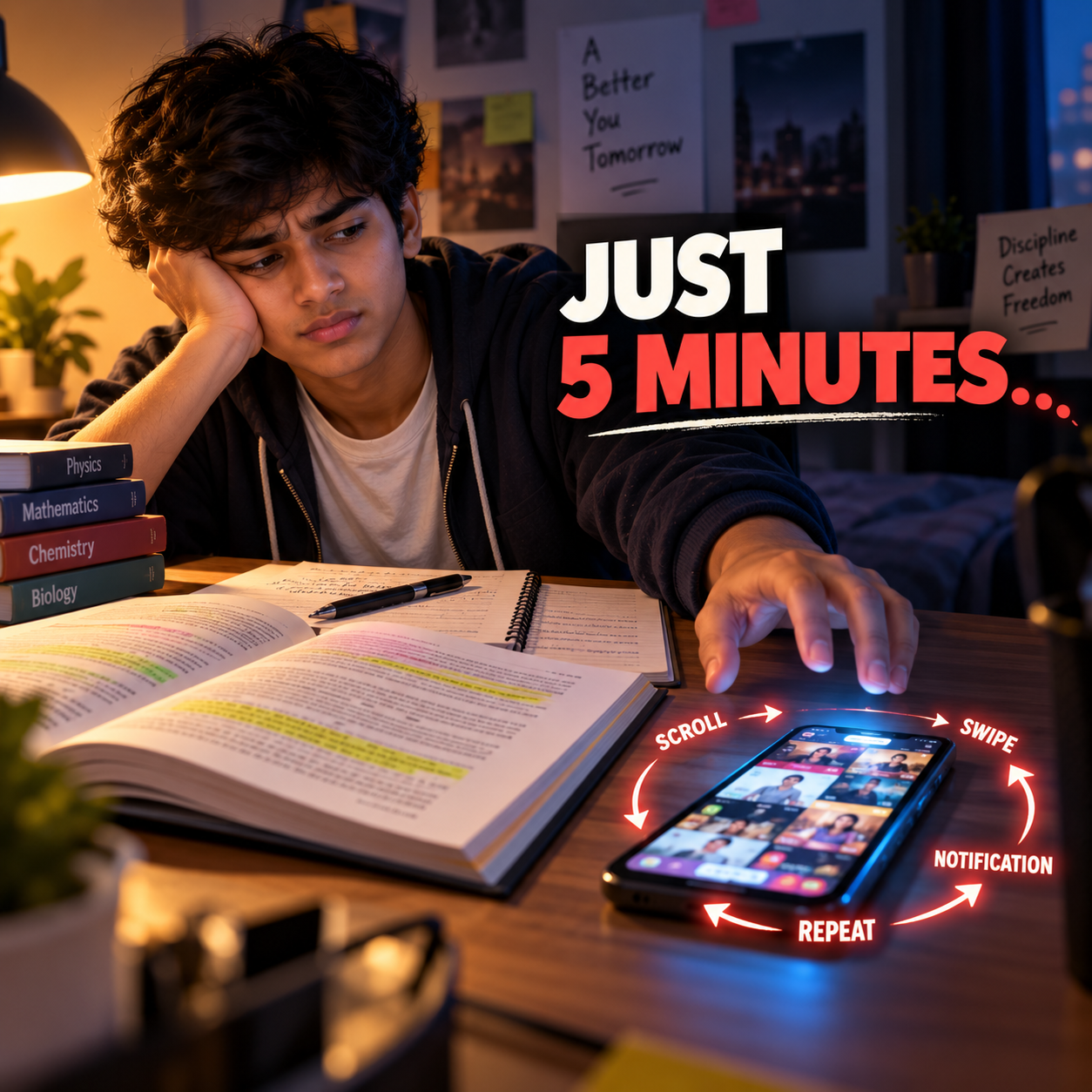
You sit down to study, open your book – and somehow end up scrolling for 40 minutes. Then comes the guilt, the lost time, and the promise to do better tomorrow.
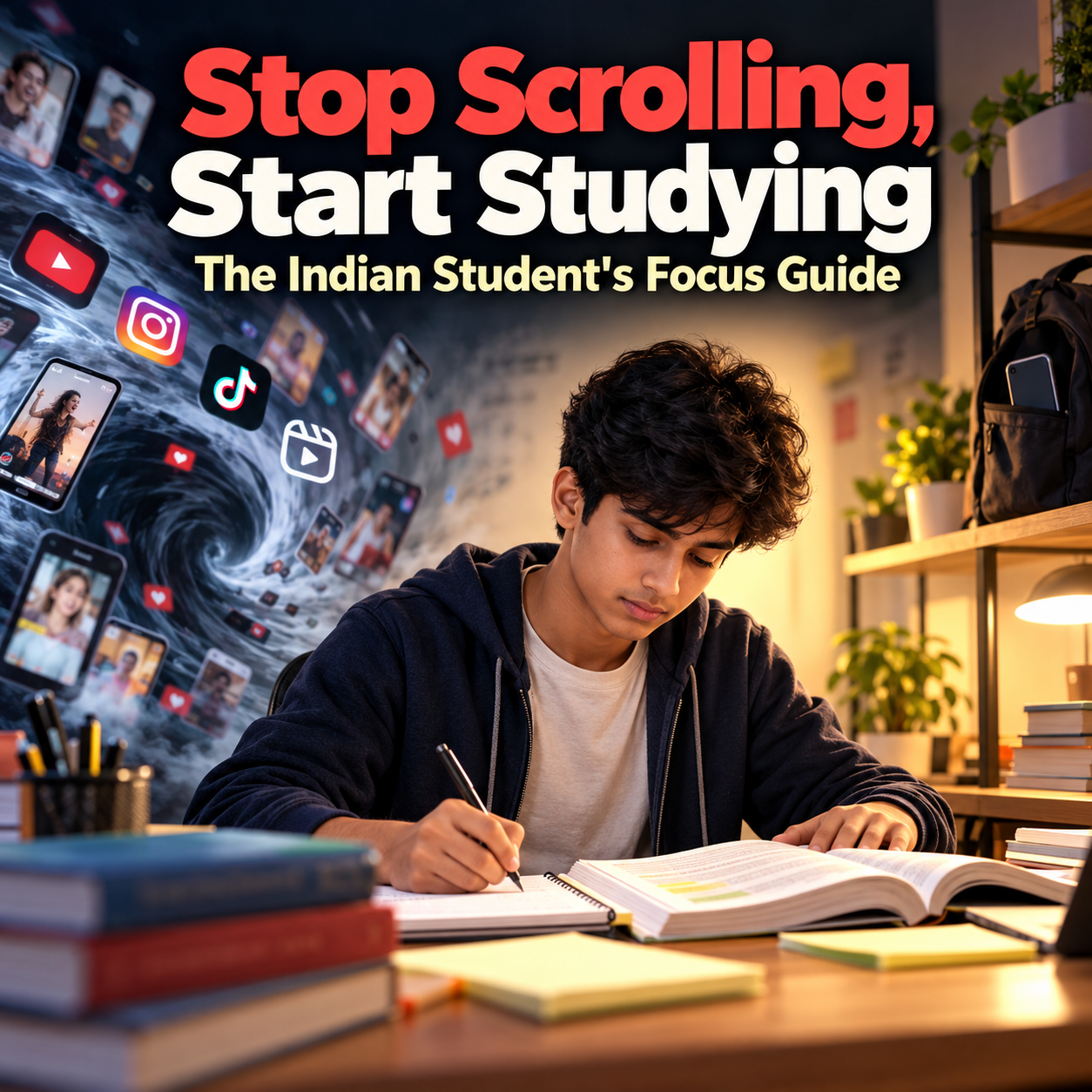
This book, Stop Scrolling, Start Studying: The Indian Student’s Focus Guide, gives you a practical system for breaking that cycle without depending entirely on willpower. It combines phone controls, Focus Blocks, study-space strategies, FOMO management, and simple progress tracking.
WHO THIS EBOOK IS FOR
Primarily for Indian students who are:
- ✅ Preparing for Board examinations
- ✅ Preparing for JEE or NEET
- ✅ Preparing for bank or SSC examinations
- ✅ Studying from home and struggling with phone distractions
- ✅ Studying in a shared or small home
- ✅ Finding it difficult to maintain consistent study sessions
It can also help students who simply want a more structured approach to studying and managing digital distractions.
WHAT YOU WILL LEARN
- ➡️ Why scrolling can feel easier than studying and how the “Scroll Trap” works
- ➡️ How phone switching and constant novelty can interfere with sustained study
- ➡️ Why simply deleting Instagram or relying on willpower may not address the underlying habit loop
- ➡️ How to distraction-proof your phone using folders, app timers, grayscale, notification controls and optional blockers
- ➡️ How to build Focus Blocks around your actual current attention span
- ➡️ How to create a consistent study setup even in a small or shared Indian home
- ➡️ How to manage FOMO, group chats and peer pressure during study time
- ➡️ How to track progress and adapt your routine without treating one bad day as failure
- ➡️ How to adjust your system during the final 30 days before Board, JEE or NEET exams
WHAT MAKES THIS EBOOK PRACTICAL
This is not simply a discussion about concentration. It gives you things to actually do.
The book includes a Scroll Audit, Habit Loop Worksheet, One-Evening Phone Reset Checklist, Focus Block Planner, Weekly Focus Review and 30-Day Final Stretch Planner.
The Focus Block method also starts from your honest current attention span rather than assuming that every student can immediately study for a fixed 25-minute period.
WHAT’S INSIDE
Chapter 1 – Understanding the Scroll Trap
Why students lose focus, the “5-Minute Lie”, common signs of the Scroll Trap and the gap between wanting to study and actually starting.
Chapter 2 – Social Media and Studying
Variable reward, attention switching, the lack of natural stopping cues and why scrolling breaks can affect what happens when you return to your books.
Chapter 3 – Willpower, Habits and Friction
The Cue → Routine → Reward loop, why deleting an app alone may not be enough, and how friction and systems can reduce automatic scrolling.
Chapter 4 – Distraction-Proof Your Phone
A six-step evening reset covering the home screen, app timers, grayscale, notifications, blockers and a distinct “study phone” state.
Chapter 5 – The Focus Block Method
Choose your starting length, prepare before the block, handle urges to check your phone and rotate subjects or task types when appropriate.
Chapter 6 – Build a Study Space in a Small Indian Home
Fixed study corners, portable setups, study signals, noise management and respectful ways to negotiate focus time with family.
Chapter 7 – FOMO, Group Chats and Peer Pressure
How to distinguish essential notifications from non-essential distractions and create boundaries without completely disconnecting.
Chapter 8 – Progress and Consistency
Simple tracking, weekly reviews, realistic goals and making one adjustment at a time.
Chapter 9 – The Last 30 Days Before Exams
A focused approach for Board, JEE and NEET students, including fixed phone windows, active recall, timed mock tests, mistake review, sleep protection and a final-month planner.
INDIA-SPECIFIC VALUE
The book is written around situations many Indian students can recognize: preparing for Boards, JEE, NEET, bank and SSC examinations; studying from home; sharing rooms or common spaces with family; dealing with coaching schedules; and managing WhatsApp or other group communications.
It does not assume that you have a private study room. It specifically provides approaches for bedrooms shared with siblings, living rooms, dining areas and other shared spaces.
AFTER READING
You can use the system to:
- Audit when and why you pick up your phone during study time.
- Reconfigure your phone to make distracting apps harder to access.
- Start Focus Blocks at a realistic length for your current attention span.
- Create a consistent study corner and a signal for uninterrupted study time.
- Establish boundaries around non-essential group chats and notifications.
- Review your weekly progress and make one practical adjustment.
- Tighten your routine during the final 30 days before an important examination.
FAQ
Who is this ebook for?
☑️ It is primarily for Indian students preparing for Board, JEE, NEET, bank or SSC examinations, as well as students who want a more structured way to study and manage digital distractions.
What will I learn from this ebook?
☑️ You will learn how to manage phone distractions, use Focus Blocks, build a workable study environment, handle FOMO and group chats, track consistency and prepare for the final exam stretch.
Is this ebook suitable for beginners?
☑️ Yes. The system starts with simple actions such as auditing phone use, changing phone settings and choosing an honest starting Focus Block length.
Is this ebook relevant to Indian students?
☑️ Yes. It specifically discusses Indian examination contexts including Boards, JEE, NEET, bank and SSC exams, as well as studying in small or shared homes.
Do I need to delete Instagram or other social media apps?
☑️ No. The book explains an alternative approach based on friction, phone settings, boundaries and replacement behaviours rather than relying solely on app deletion.
Do I need a separate study room?
☑️ No. The book provides practical approaches for shared bedrooms, halls and other small or shared spaces.
What is a Focus Block?
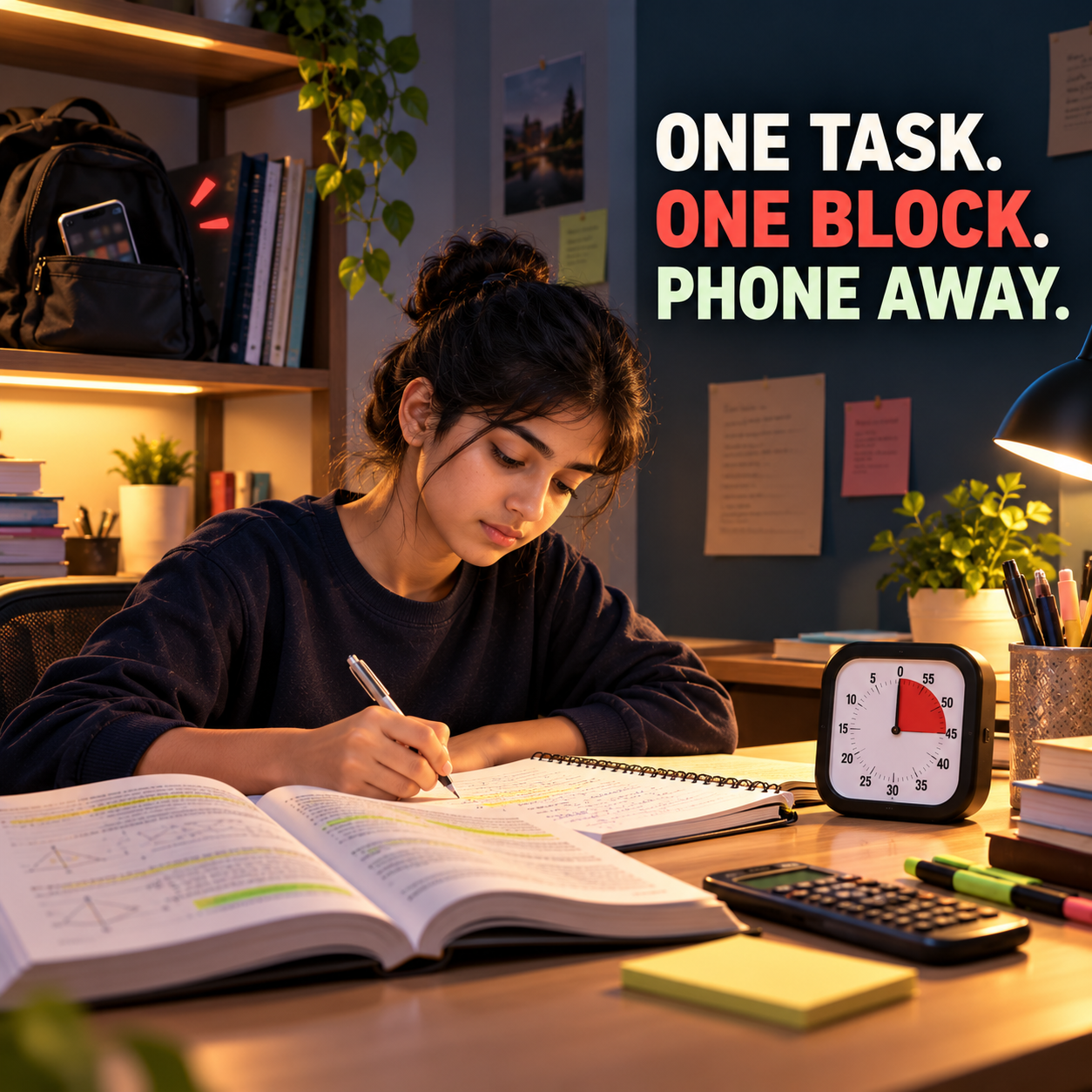
☑️ A Focus Block is one specific task completed for a fixed period with the phone out of reach. Its duration is based on your current attention span rather than a fixed 25-minute requirement.
Stop relying on the promise that you will “focus harder tomorrow.” Build a study system that makes focused work easier to start and distractions harder to reach.
Start with your next Focus Block.